Dust and Devotion: Why Indie Record Stores Are the Last Sacred Spaces for Underground Music
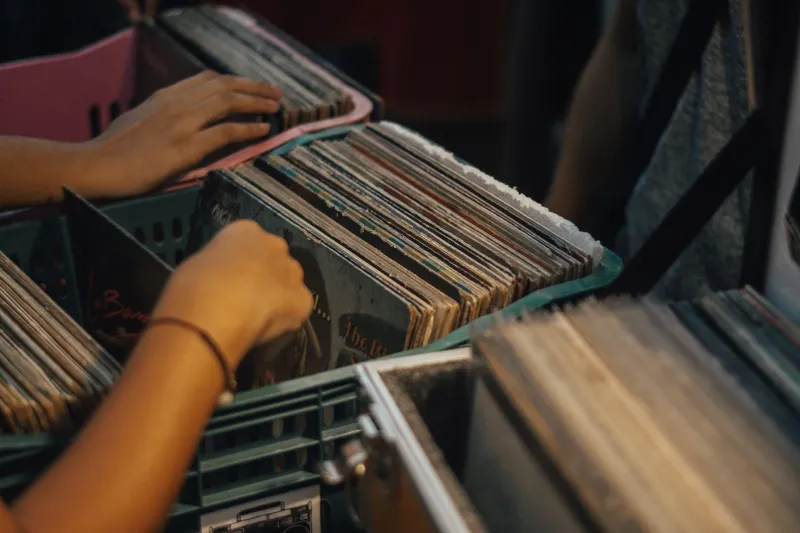
Walk into the right record store on a Saturday afternoon and something shifts. The fluorescent buzz of a strip mall gives way to the warm crackle of a needle hitting wax. Handwritten tags describe albums in language no algorithm has ever been trained to generate — "funeral doom for long drives in November" or "post-punk for people who read Camus in high school and never really stopped." This is curation with a pulse. And for the underground music community, it might be the last line of defense against a culture that wants everything streamlined, sanitized, and served to you in a 30-second preview.
Spotify doesn't know what you need. It knows what you clicked last Tuesday. There's a difference, and the people running independent record stores in cities like Chicago, Portland, New Orleans, and Richmond have built entire ecosystems around that distinction.
The Algorithm Doesn't Go to Shows
Let's be honest about what streaming platforms actually do for dark and underground music: not much. Sure, you can find a Bauhaus record on Apple Music. But the discovery pipeline — the way you stumble onto something genuinely weird and life-altering — is almost entirely broken in digital spaces. Recommendation engines are built to minimize churn, not maximize revelation. They want you comfortable, not challenged.
Independent record stores operate on a completely different logic. The person behind the counter at a well-run indie shop isn't optimizing for engagement metrics. They're optimizing for the look on your face when you hear something that rewires your brain. That's a fundamentally different goal, and it produces fundamentally different results.
Mike Harlow, who runs a small but fiercely curated shop in Chicago's Logan Square neighborhood, puts it plainly: "We stock what we believe in. If a distributor sends us something that sounds like it was designed by committee, it goes back. We're not a library of everything — we're a library of what matters." His shelves carry black metal imports, limited cassette runs from Pacific Northwest noise artists, and a rotating section he just calls "the difficult stuff." It moves. Not fast, but it moves to the right people.
Crate Digging as a Political Act
There's a reason the phrase "crate digging" has never fully translated to a streaming context. You can't replicate the physical act of flipping through records — the serendipity of a cover catching your eye, the weight of the vinyl in your hand, the conversation it sparks with a stranger two bins over who recognizes what you're holding. These are embodied experiences, and in a music culture increasingly mediated through glass screens and earbuds, they carry a kind of countercultural weight.
For collectors deep in the dark and underground spaces — doom metal, darkwave, industrial, black ambient, death rock, noise — crate digging isn't just a pastime. It's an assertion that music deserves more than passive consumption. Every dollar spent at an independent shop is a vote against the Spotify royalty model that pays fringe artists fractions of a cent per stream. Every hour spent flipping through a used bin is time not spent on an algorithm's turf.
Jasmine Cortez, a collector based in Austin who has been hunting for obscure darkwave and minimal synth for over a decade, describes it as almost meditative. "When I'm digging, I'm present in a way I never am when I'm scrolling. There's no notifications, no related content, no 'you might also like.' It's just me and the record and whatever I'm willing to risk on something I've never heard." That risk, she argues, is precisely the point. Discovery without risk isn't really discovery.
The Store as Community Infrastructure
What separates a genuinely vital independent record store from a boutique novelty shop isn't just the inventory — it's the function the space serves in the broader community. The best indie stores double as informal venues, zine libraries, bulletin boards for local shows, and gathering places for people who feel alienated by mainstream music culture. In smaller cities especially, they're often the only physical space where someone into experimental or dark music can walk in and immediately feel like they belong.
In Richmond, Virginia, a shop known for its deep selection of post-punk, goth, and metal regularly hosts in-store listening sessions where customers bring records to play for the room and make the case for why it matters. No social media required. No streaming link in bio. Just people in a room arguing passionately about music, which is how it's supposed to work.
This community function is hard to quantify and impossible to replicate online, and it's exactly why these stores matter beyond the transactional. They create the conditions for subcultures to reproduce themselves — for a 19-year-old to walk in curious and walk out converted, with three records under their arm and a show to go to on Friday.
Gatekeeping, Reclaimed
"Gatekeeping" has become a dirty word in internet music discourse, and fair enough — exclusionary gatekeeping based on who you know or how you dress has always been toxic. But there's another kind of gatekeeping that independent record stores practice, one that's actually essential: the gatekeeping of quality, context, and meaning.
When a shop owner decides what to stock, what to display face-out, what to recommend to a nervous first-timer, they're making editorial decisions that shape how music gets understood and valued. That's not corporate manipulation — that's human judgment, informed by years of listening and caring. It's the difference between a curator and a content delivery network.
For dark and underground music especially, this matters enormously. These genres don't have major label marketing budgets. They don't get synced to TV shows or pushed to playlist curators. They survive because people who love them tell other people who love them, and independent record stores are one of the primary spaces where that transmission happens.
Why This Matters Right Now
Record Store Day gets a lot of attention every April, and it's fine for what it is — a promotional event that drives some foot traffic and moves some limited pressings. But the real story isn't one day a year. It's the stores that are open every Tuesday when nobody's watching, maintaining a space for music that refuses to make itself easy.
In a moment when streaming consolidation is accelerating, when major labels are swallowing indie distributors, and when AI-generated music is starting to flood digital platforms with content that technically qualifies as "music" without being anything at all — the physical, human, stubbornly analog nature of independent record stores feels less like nostalgia and more like necessity.
The underground has always found ways to survive. Tape trading networks, zine culture, DIY touring — every era produces its own infrastructure of resistance. Right now, that infrastructure runs through the bins of independent record stores, staffed by people who care too much about music to let it disappear into a recommendation queue.
Dig accordingly.